

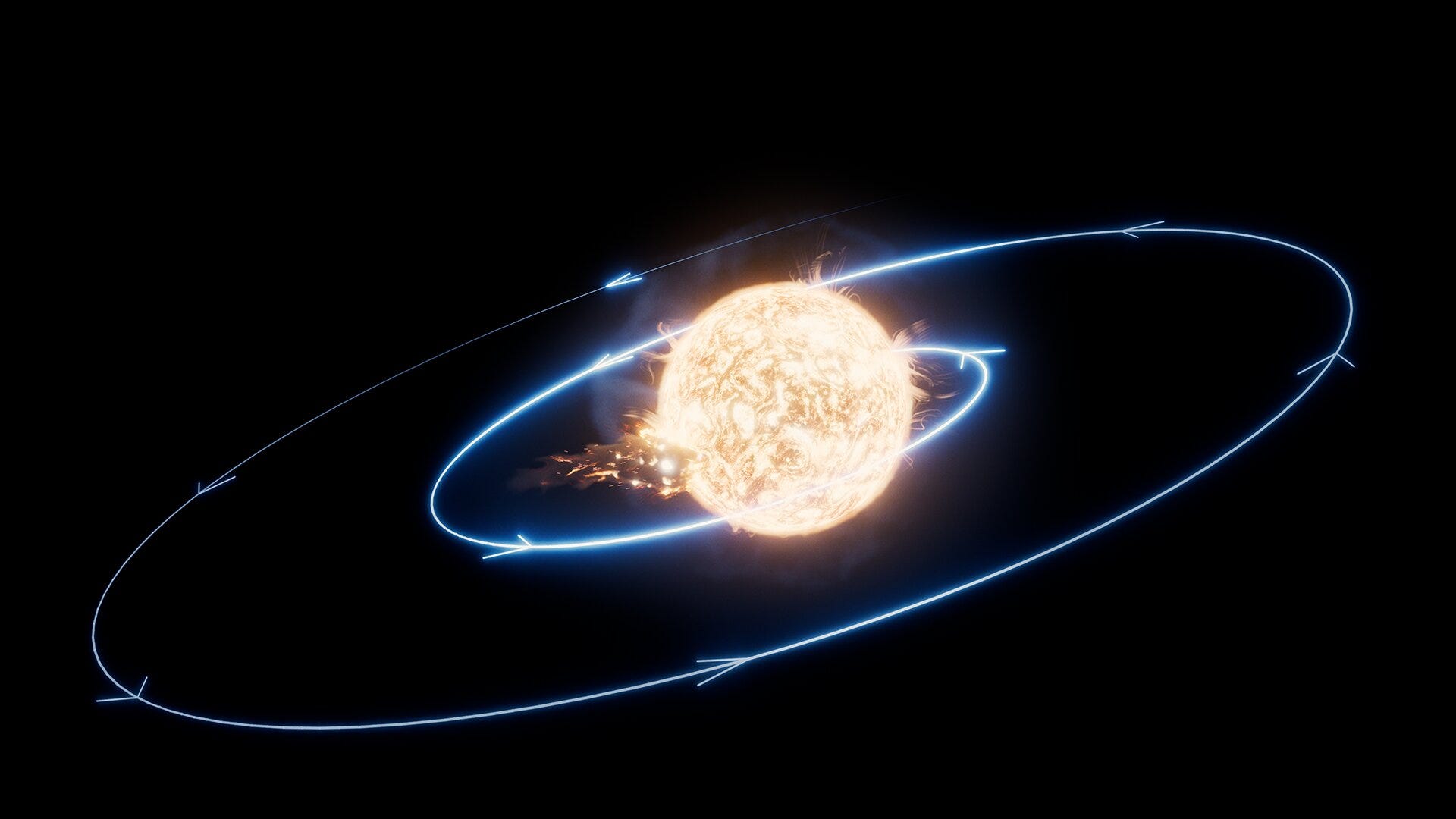
In Roman mythology, there was a prophecy that one of Saturn’s children would overthrow him.
Saturn’s rather alarming reaction was to devour his son, thus preventing the impending calamity. Spanish artist Francisco Goya even painted a disturbing portrayal of the act.
This week astronomers have just announced evidence for the astronomical equivalent - a star gobbling up one of its planets.
The monster in question is the Sun-like star TOI-5882, which sits some 1300 light years from Earth.
Astronomers found that it contains particularly high levels of lithium. Planetary material usually contain more lithium than stars, so the star may have swallowed one of its planets.
The official astronomical term is engulfment.
In one of the better quotes from astronomers I’ve seen in a while, lead astronomer Brooke Kotten (University of Michigan) said: “You are what you eat, right?”.
But there’s a twist…
TOI-5882 may not have been acting alone. Its accomplice - a brown dwarf that also orbits the star - could have helped steer the unlucky planet towards oblivion.
A brown dwarf is an object part way between a planet and a star. This one is 20 times more massive than Jupiter.
TOI-5882 is so enriched with lithium that if you lined it up with 99 other similar stars, only three would have higher levels of the element.
📸 Image of The Week

Measuring more than 800,000 kilometres across, this coronal hole is an area of cooler plasma that can act as a source of the solar wind.
🏛️ From the Club’s Museum of Cosmic Curiosities
Exhibit 037 - The Astronomical Playing Cards of 1829
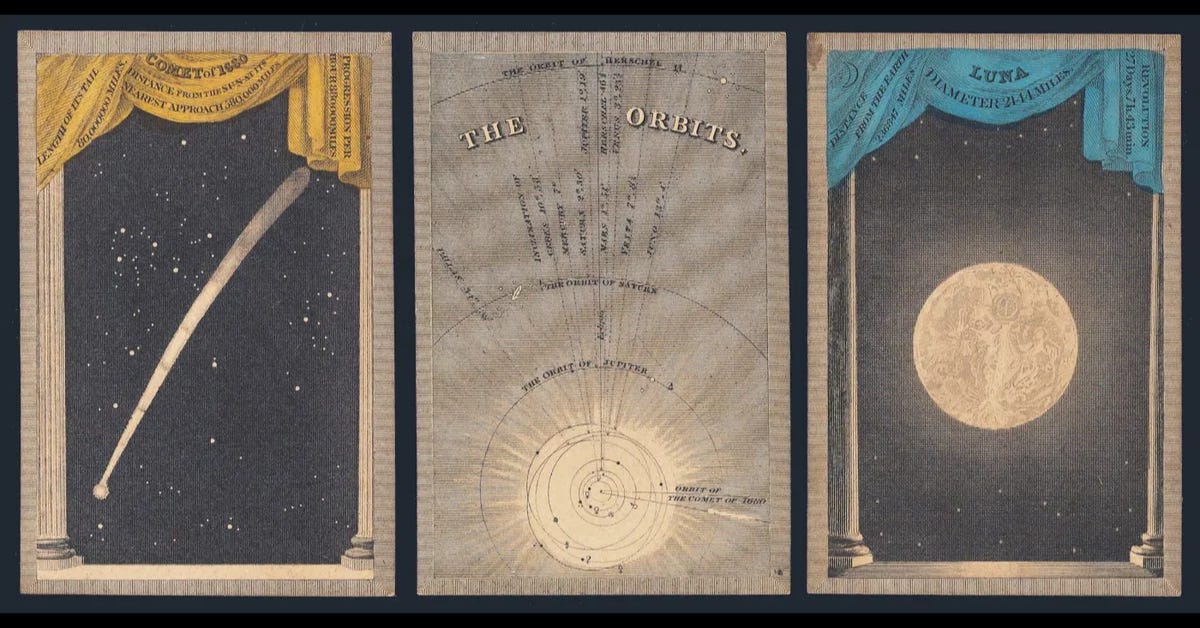
I am a big board gamer, with a penchant for card games too. So I was excited when I recently came across a set of beautiful 19th century playing cards adorned with celestial objects.
They are part leisure activity, part educational endeavour. The constellation cards tell you when each one is visible. The cards for objects like the Moon come with vital statistics such as diameter and distance from the Earth.
The cards also came with a guide to using them to play two different games called Conjunction and Combination. The games seem similar to Whist, with players competing in pairs through trick taking. The four suits are based on the seasons and the zodiac cards have a higher value than the others.
It was clearly an early piece of science communication, the author writing they hope to:
“excite the youthful reader to seek a more extensive knowledge of this noble science, or lead [them] to contemplate, with reverent admiration, the power and wisdom, — the harmony and magnificence, — displayed in the construction of the Universe.”
You can browse the full collection and the rules booklet online through the Yale Library.
🧭 Like this?
Your Astronomy Club membership comes with a free pass to the full Museum of Cosmic Curiosities, a growing cabinet of strange, profound & surprising objects from the history of astronomy and space exploration.
In other news…
Consciousness likely not unique to Earthlings, philosopher claims

Radionuclides trapped in a deep-sea sample point to an ancient hypernova
Scientist creates ‘mini‑universe’ to measure time without a clock